
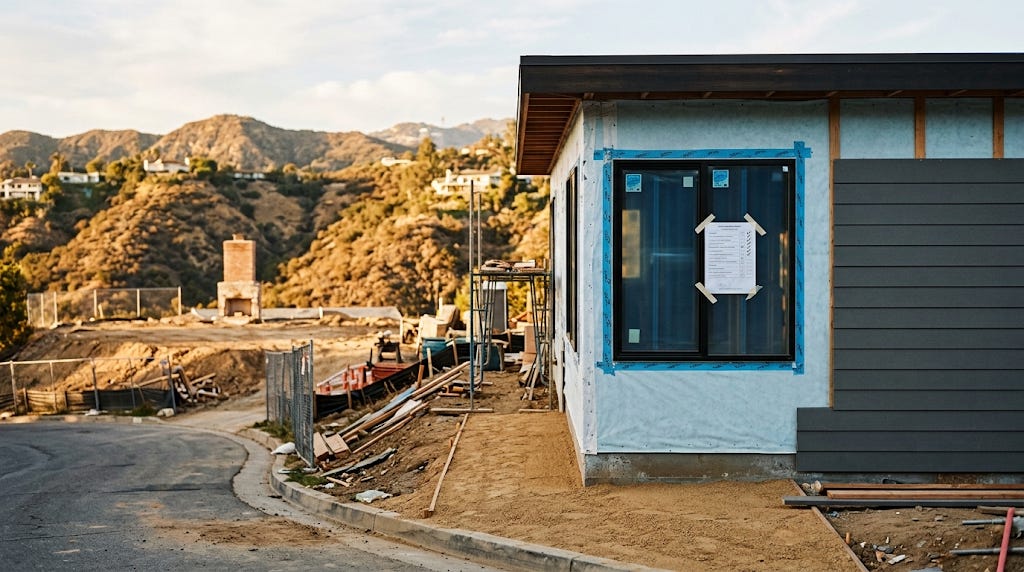
In brief: On September 16 State Farm filed to write new California homeowners policies for the first time since 2023 and tied eligibility to the IBHS Wildfire Prepared Home designation. I read the designation's checklist. The tier that opens the door in the high-hazard zones is the one IBHS itself calls a new-construction tier, so the offer mostly reaches rebuilds and new builds. It is still most of the certificate I said was missing last week. Which house it is for is the question.
Last week I described a conversation happening in a few hundred thousand kitchens. The landscaper's bid is on the table, and one of you asks the only question that makes the arithmetic work. Will it help with the insurance?
I said the law's answer was narrower than people assume. The regulation that credits your first five feet is a pricing rule. Nothing in its text obliges anyone to sell you a policy. The requirement was compulsory and dated. The reward was discretionary and revocable. What was missing, I wrote, was a certificate: a document that travels with the building, means the same thing to every carrier, and does not evaporate when you switch companies.
Three days after that went out, the largest home insurer in California filed to sell policies again, and it named the price of entry. Not a dollar figure. A certificate.
That is closer to what I asked for than I expected to see this year, and I want to give it its due before I read the fine print. The fine print is where the essay is.
What was filed
On September 16, State Farm General asked the Department of Insurance for permission to write new homeowners policies for the first time since May 2023. It insures about a million homes in the state.
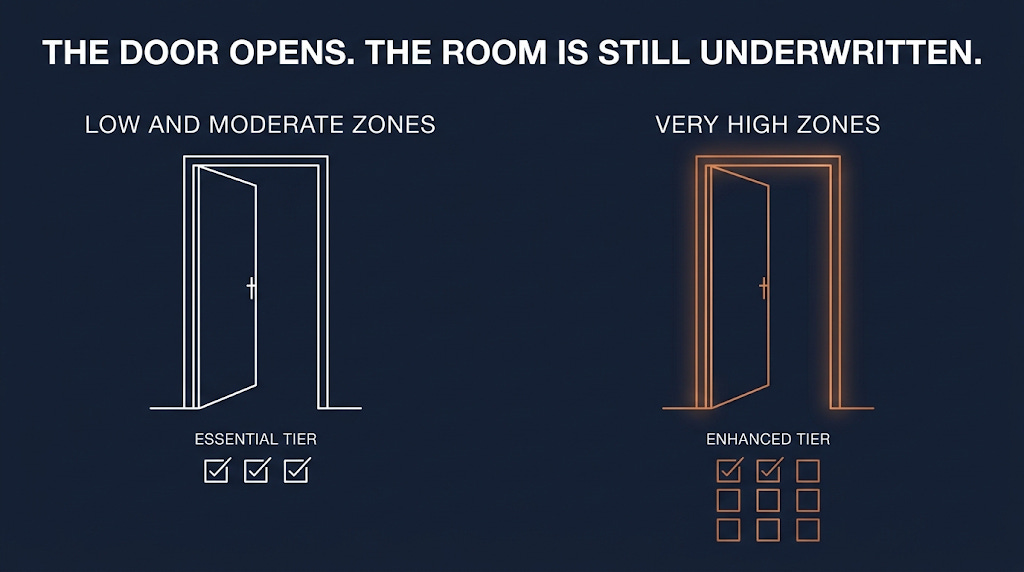
The filing, as described in the Department's announcement and by the company's spokesperson, works like this. A home anywhere in California that holds the Insurance Institute for Business and Home Safety's Wildfire Prepared Home designation at its higher tier becomes eligible to apply. IBHS is renaming that tier from Plus to Enhanced this year; the requirements are unchanged. A home that holds the lower tier, Base, now called Essential, becomes eligible only in low and moderate wildfire severity areas. Eligible, in both cases, means eligible to be underwritten. The designation opens the door. It does not walk you through it.
Early reports said the company would cap the program at 7,500 policies a year. The San Francisco Chronicle corrected that, and State Farm's spokesperson says there is no set cap. Hold onto that, because it matters later. The limit on this program is not a number in the filing. The limit is the standard.
Two weeks earlier Allstate had filed to come back too, after nearly four years, on different terms: an overall rate increase of 1.4 percent, and a commitment to write at least 2,064 new policies by July 2029 against a book of just under 350,000. That is six tenths of one percent.
The Commissioner called the filings "a starting point, not a finish line." Neither is approved. State Farm has said that if its filing is, it would open for new business in December.
Before you read on, make one guess and write it down. What share of California's existing homes could earn the Enhanced designation today, as they stand?
The certificate
A designation is only as good as the list it enforces, so I read the list.
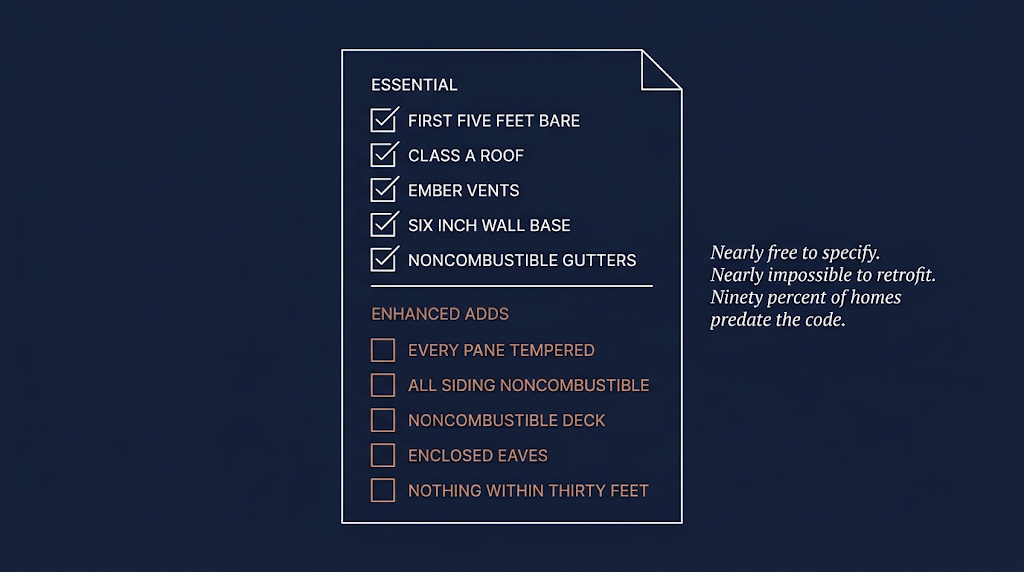
Essential requires what you would expect, and enforces it harder than most people do. The first five feet around the house must be free of anything that burns, down to bare mineral soil or hardscape, with no exceptions. Defensible space to thirty feet. A Class A roof. Noncombustible gutters. Six inches of noncombustible material at the base of every wall. Ember-resistant vents or eighth-inch mesh. No more than three detached structures within thirty feet, each at least ten feet from the house. The application fee is $125. The designation lasts three years, with a photo-based review after the first and second year.
Enhanced keeps all of that and adds the building itself. Enclosed eaves. Every exterior window with at least two panes of tempered glass. All exterior wall covering noncombustible. Decks noncombustible, new or retrofit. Doors noncombustible or solid-core. Noncombustible exhaust vents. Gutter covers. No back-to-back combustible fences. And no structures within thirty feet at all.
If you have spent time with the state's wildfire construction code, the rules that have governed new construction in the high-hazard zones since 2008 and that moved this January from Chapter 7A of the Building Code into Part 7 of Title 24, the Wildland-Urban Interface Code, that second list reads like that code with several dials turned past it. The code accepts ignition-resistant siding; Enhanced wants noncombustible. The code asks for one tempered pane in a window; Enhanced wants every pane. The code regulates how a nearby accessory structure is built; it does not say one cannot stand there. Enhanced wants nothing there.
IBHS says so itself, in plain words. The higher tier is "commonly pursued during new construction or major exterior renovations."
Now the guess. The Board of Forestry's own Zone 0 FAQ says about 90 percent of California's homes were built before that 2008 code existed. I could not find a published count of Wildfire Prepared Home designations, in California or anywhere. IBHS publishes counts for its hurricane program, FORTIFIED, which passed 100,000 homes this spring. For the wildfire program I found no number. So the answer to the question I asked you is that nobody outside IBHS knows, and the shape of the list tells you the number is small.
Two doors
Draw the map. The Essential door opens in the low and moderate severity zones, where the physics is already on the homeowner's side. The Enhanced door opens in the high and very high zones, where the FAIR Plan has been absorbing the demand: 696,562 policies statewide as of June, up 157 percent in under four years. And Enhanced is the tier IBHS describes as a new-construction tier.
Read as an engineer reads a load path, the filing routes the existing high-hazard housing stock through the tier it is least likely to hold, and the low-hazard stock through the tier it could earn with a weekend, a roof, and a vent order.
That is not a trick, and I do not read it as one. It is what a company pricing exposure would do after January. But it means the reopening is, for now, an offer to two groups: the people rebuilding in Altadena and the Palisades, and anyone building new in the wildland-urban interface. For them it is a large deal, because the marginal cost of Enhanced on a house you have not built yet is small. A Headwaters estimate carried in the Department's own briefing put it at about $15,000 on a $500,000 standard build in Altadena. On that estimate, three percent of the build buys a place in line with the largest carrier in the state.
For the existing house on the hill, the list is siding, every window, the deck, and whatever is standing within thirty feet. That is not a landscaper's bid. That is a general contractor and a permit.
What it fixes
Credit where it is due, because last week's essay was a complaint about a missing part, and this is most of the part.
IBHS is funded by the insurance industry collectively and owned by no single carrier. The designation is issued against a published checklist, lasts three years, and means the same thing whether the underwriter works for State Farm, Mercury, CSAA, Farmers or USAA, all of which are listed program partners. CSAA has tied a three-year renewal guarantee to it. The state's pricing rule binds what a carrier must consider when it builds your price. A designation like this begins to bind whether a carrier will look at you at all. That is the other half of the load path, the half the regulation does not carry, and it was built by a research lab in South Carolina, not by a regulation.
What it does not fix is also clear. Nothing reported sets a floor on how many policies State Farm writes, and Allstate's floor is six tenths of a percent. The tier that opens the high-hazard door is the new-build tier. Nobody publishes how many homes hold either tier. And eligibility is still subject to underwriting, which means the door can open and the room can still be closed.
What to do this week
Pull the IBHS checklist. It is free and two pages. Walk your house with it and count the items you cannot do without a contractor. If the count is zero and you are in a low or moderate zone, you are an Essential candidate, and if the filing is approved that door may open in December.
If you are rebuilding after Eaton or Palisades, put the Enhanced tier on the drawings now, by name. Three percent of the build, on the one estimate I have, and it does not get cheaper after the framing goes up.
If you are in a very high zone in an existing house, three items decide it: siding, windows, deck. Get those three quoted before you decide anything else. The landscaping alone will not get you through this door, and it is worth knowing that before you spend on the landscaping.
And ask any carrier on the partner list what the designation actually gets you. Eligibility, a discount, and a renewal guarantee are three different things, and the answer differs by company.
What is actually new
The state told the owners of two million structures in its highest-hazard zones what to do to their buildings. The largest insurer in the state has now told them what it would take to be a customer again. The two lists agree on the first five feet and part company on everything above it.
A carrier has now tied its door to the certificate. That is progress, and I will take it. The question it leaves on the kitchen table is a harder one than the one I started with.
Which house is the certificate for: the one you have, or the one you would have to build?
Nate Wittasek is a licensed fire protection engineer, founder of UpResilience, and a Principal at Simpson Gumpertz & Heger. He writes about how buildings, codes, and insurance actually behave under stress.
Sources
San Francisco Chronicle, State Farm files to write new California home insurance policies, September 16, 2026 (with correction: no cap on the number of new policies). https://www.sfchronicle.com/california/article/state-farm-home-insurance-22435218.php
ABC10, State Farm, Allstate file plans to resume writing new California home insurance policies, September 2026. https://www.abc10.com/article/money/business/state-farm-allstate-file-plans-to-resume-writing-new-california-home-insurance-policies/103-ec9a3353-09a0-4d43-b374-ccc2362c0d8c
Sacramento Bee via InsuranceNewsNet, Allstate, State Farm seek limited rollout of new California home insurance policies, September 2026. https://insurancenewsnet.com/oarticle/allstate-state-farm-seek-limited-rollout-of-new-california-home-insurance-policies
Insurance Business, Allstate moves to reopen California home insurance market for first time in four years, September 4, 2026. https://www.insurancebusinessmag.com/us/news/breaking-news/allstate-moves-to-reopen-california-home-insurance-market-for-first-time-in-four-years-588803.aspx
State Farm General, Update on California (May 2023 pause; policy counts). https://newsroom.statefarm.com/state-farm-general-insurance-company-update-on-california-2-2025/
IBHS, Wildfire Prepared Home: How to Prepare My Home checklist (Base and Plus requirements). https://wildfireprepared.org/wp-content/uploads/WPH-How-To-Prepare-My-Home-Checklist.pdf
IBHS, Wildfire Prepared Home FAQ ($125 fee, three-year term, annual review). https://wildfireprepared.org/frequently-asked-questions/
IBHS, Base vs Plus, and June 9, 2026 release on renaming to Essential and Enhanced. https://wildfireprepared.org/wildfire-prepared-home-base-vs-plus/ and https://ibhs.org/ibhs-news-releases/ibhs-rounds-out-wildfire-prepared-program-with-neighborhood-and-multifamily-standards-updates-home-requirements/
IBHS, FORTIFIED surpasses 100,000 designations, May 20, 2026. https://ibhs.org
California Department of Insurance, Wildfire Safety and Insurability Briefing, March 2026 (Headwaters $15,000 Plus increment on a $500,000 Altadena build). https://www.insurance.ca.gov/0400-news/0100-press-releases/2026/upload/nr017CDIWildfireSafetyandInsurabilityBriefing032720262-2.pdf
Insurance Journal, CSAA three-year renewal guarantee for Wildfire Prepared Home designees, September 10, 2026. https://www.insurancejournal.com/news/west/2026/09/10/884417.htm
Board of Forestry and Fire Protection, Frequently Asked Questions about Zone 0, September 17, 2025 (Q23: about 90 percent of homes predate the 2008 code). https://bof.fire.ca.gov/projects-and-programs/defensible-space-zones-0-1-and-2
California FAIR Plan, Key Statistics and Data, June 2026. https://www.cfpnet.com/key-statistics-data/
2025 California Wildland-Urban Interface Code, Title 24 Part 7 (effective January 1, 2026), consolidating former California Building Code Chapter 7A (2022; Sections 707A, 708A, 710A), CRC R337 and CFC Chapter 49. Exterior wall covering, Section 504.5.2; glazing, Section 504.8; accessory structures, Section 504.11. https://codes.iccsafe.org/content/CAWUIC2025P1
Board of Forestry and Fire Protection, Zone 0 FAQ, Q7 (CAL FIRE estimate: 1.25 million SRA structures plus 870,000 LRA very high structures). Same URL as above.
Zoning codes in the Palisades are for houses to be 4-5 feet apart on each side, so what does 30 feet refer to?