Zone Zero's Hidden Bill
California's ember-resistant zone is the most important five feet in wildfire survival — and the cost number everyone is fighting over is the wrong number. The sticker price isn't what stops people. The repair it drags behind it is.

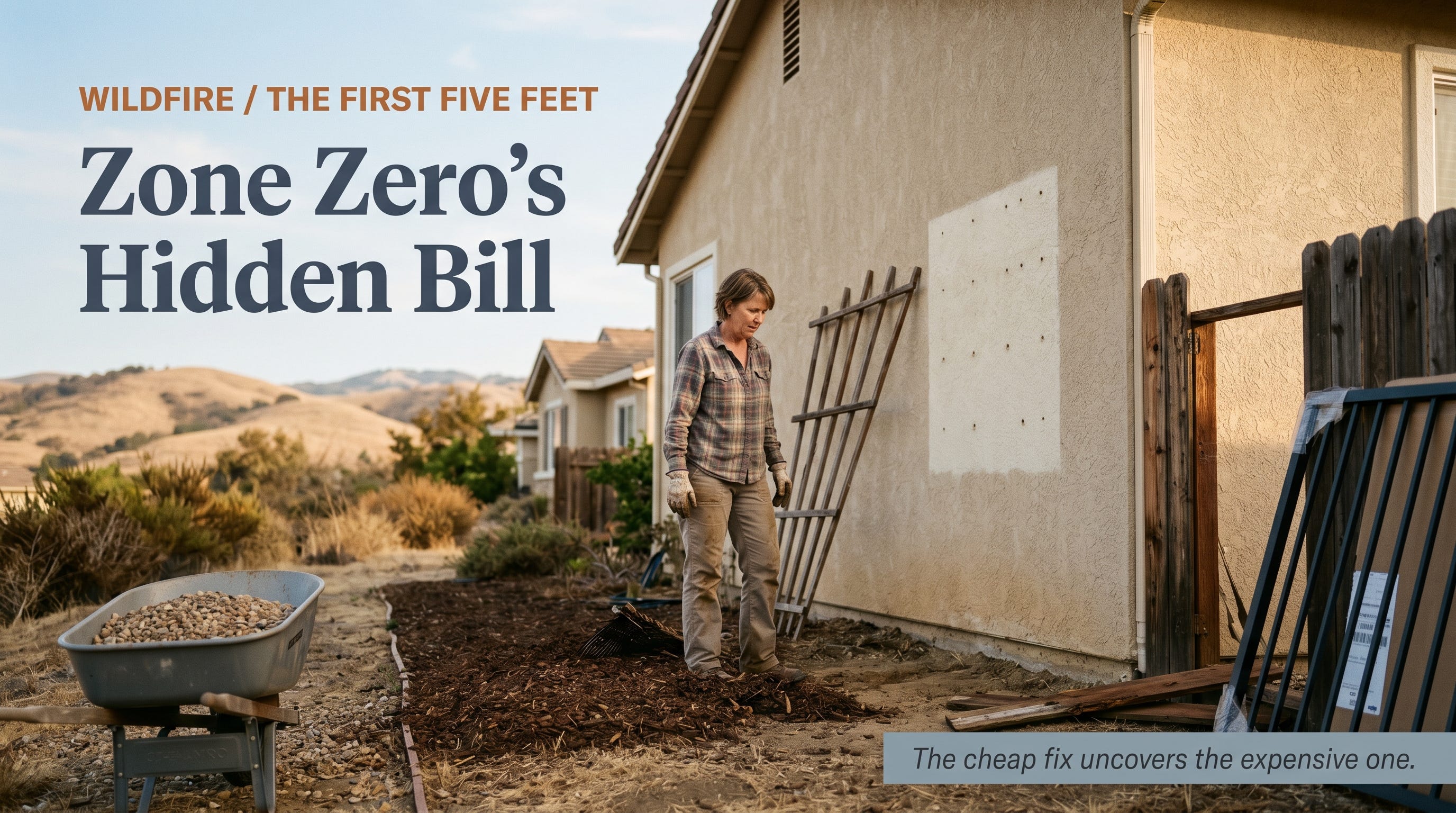
A homeowner in a very-high-fire-hazard ZIP code reads that California is about to require a “Zone 0” — five feet of non-combustible space hard against the house — and does the sensible thing. They get a number. Pull the wood mulch, lay gravel, swap the wooden gate for a metal one. A few hundred dollars of fence, a weekend of mulch. Annoying, affordable, done.
Then they actually start, and the five feet fights back.
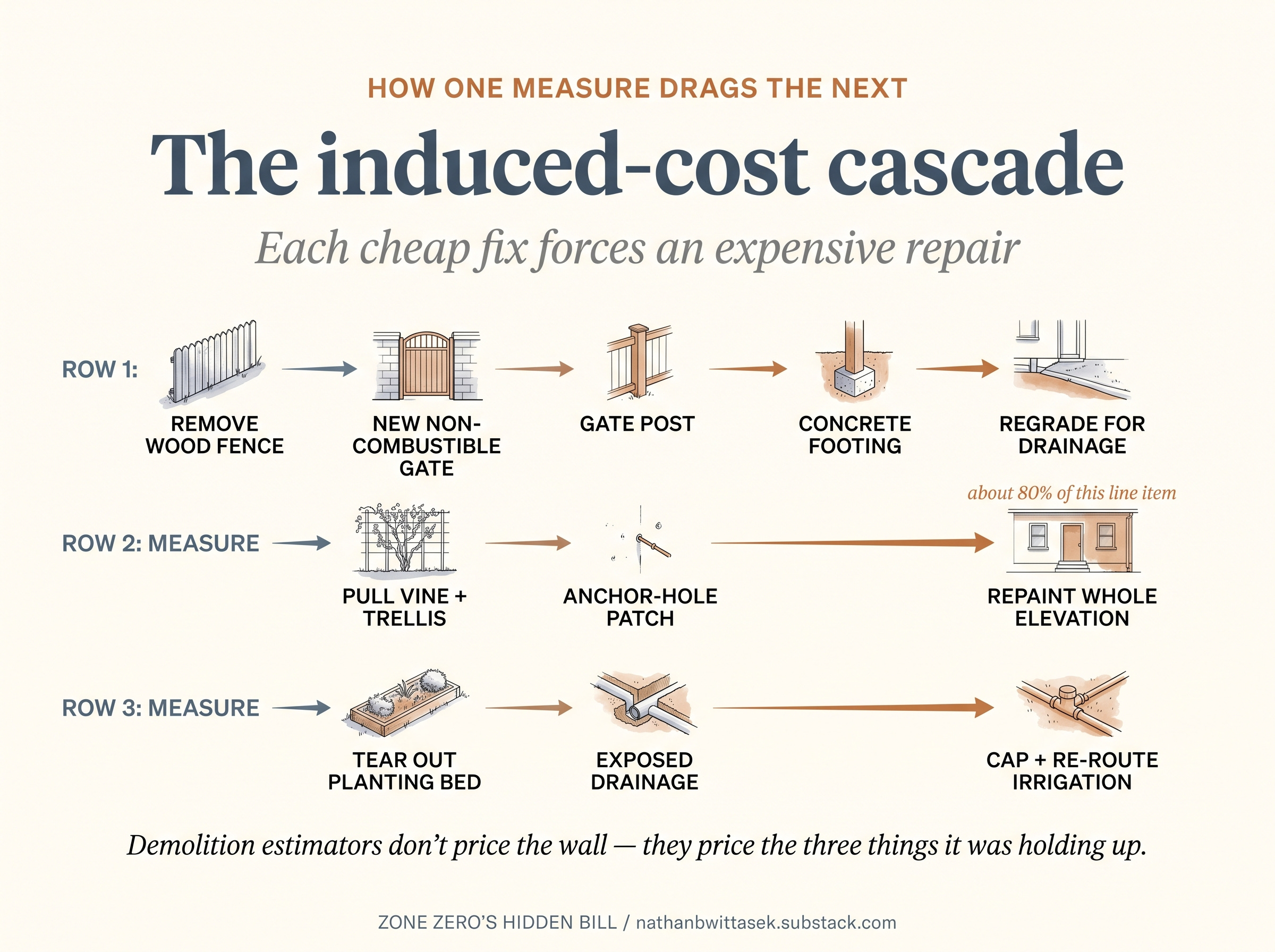
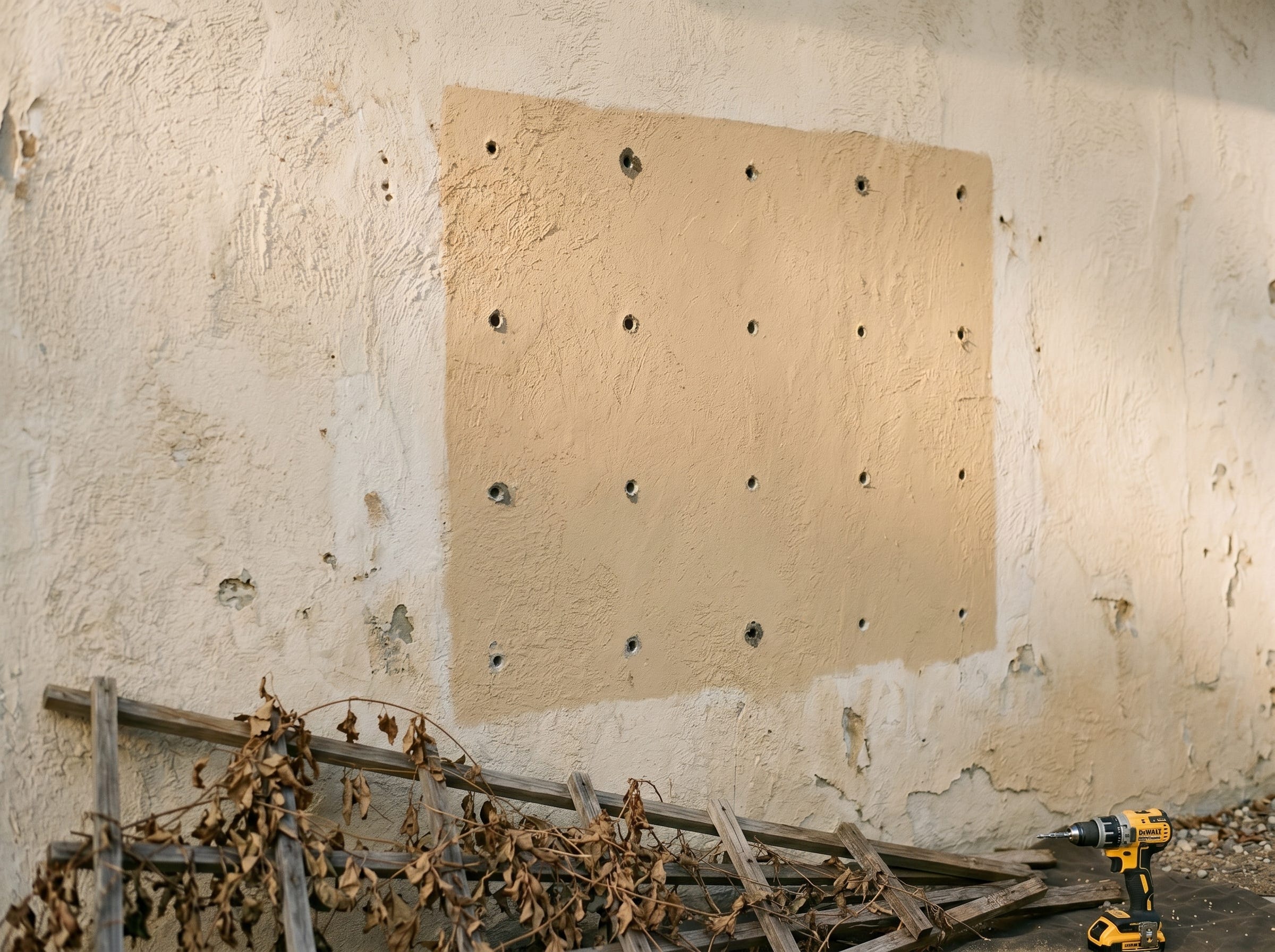
The vine they pull off the wall was holding a trellis bolted into the stucco. Pull the trellis and you’ve got a grid of anchor holes and a rectangle of wall that’s a different color than everything around it, because the rest of the elevation has been fading in the sun for nine years and that patch hasn’t. Now you’re not patching stucco — you’re repainting the whole side of the house, because paint doesn’t color-match a nine-year-old wall. The wood fence comes out easily enough, but the first five feet of it was carrying a gate, so now you need a non-combustible gate, and the gate needs a post, and the post needs a footing, and while the trencher is there you should fix the grade so water stops running toward the foundation. The cheap line item quietly dragged an expensive one behind it.
That gap — between the measure and the repair the measure forces — is the whole fight over Zone 0 right now, and almost nobody is costing it honestly.
The rule that stalled on a number
Zone 0 is not exotic. It comes from the same physics every post-fire forensic report keeps finding: most homes that burn in a wildfire are not torched by a wall of flame arriving from the wildland. They’re lit by embers — burning fragments carried on the wind, landing in the receptive fuel pressed up against the structure. The mulch bed. The doormat. The dry vine. The wood fence that runs straight into the siding like a fuse. Take the fuel out of the first five feet and you take away the ember’s landing pad. California wrote this into law with AB 3074 in 2020, amended it with SB 504 in 2024, and directed the Board of Forestry to write the actual Zone 0 standard.
It hasn’t been written. The Governor ordered the Board to finish by the end of 2025. The Board missed the deadline, paused the rulemaking, and pushed the work into 2026. As I write this, there is still no adopted statewide Zone 0 standard, and most of California heads into another fire season without one. A few jurisdictions haven’t waited: Berkeley adopted its own Zone 0 ordinance, effective January 1, 2026, and is enforcing it in its highest-hazard hill neighborhoods — inspections underway, penalties for noncompliance. The missing piece is the statewide rule that would make the five feet uniform across every hillside, not the idea itself.
Here is the part worth sitting with: the rule didn’t stall on the physics. The physics is settled. It stalled on the cost. The loudest objections — and they came hardest from Southern California homeowners and the landscape trade — were about money and about what five bare feet does to a shaded yard. One widely-cited figure put ember-resistant renovations on a single home near Auburn at around $13,000. Multiply that across every house on every hillside and you understand why a board full of reasonable people decided they’d rather be late than wrong.
So the cost question isn’t a footnote to the Zone 0 debate. It is the debate. Which makes it strange that the number almost everyone is using is the sticker price — and the sticker price is the wrong number.
Direct cost versus loaded cost
When a contractor quotes Zone 0 work, they quote the direct measure: remove the mulch, install the gravel, replace the fence section, swap the gate. Those numbers are real and they’re not the problem. The numbers I work with — the per-measure costs in the inspection model we use to score properties — put the common Zone 0 measures at a few hundred to a few thousand dollars each. Pull-and-replace combustible ground cover: a few hundred. Non-combustible fence section and gate: a couple thousand. Clear the vines: almost nothing.
The problem is everything those measures set in motion.
Engineers have a habit of separating two kinds of cost: the first-order cost of the thing you’re doing, and the induced cost of the repairs your action makes necessary. Demolition estimators live in this distinction — you don’t price the wall you’re removing, you price the three things that wall was holding up. Zone 0 is dense with induced cost, and the published estimates almost universally ignore it.
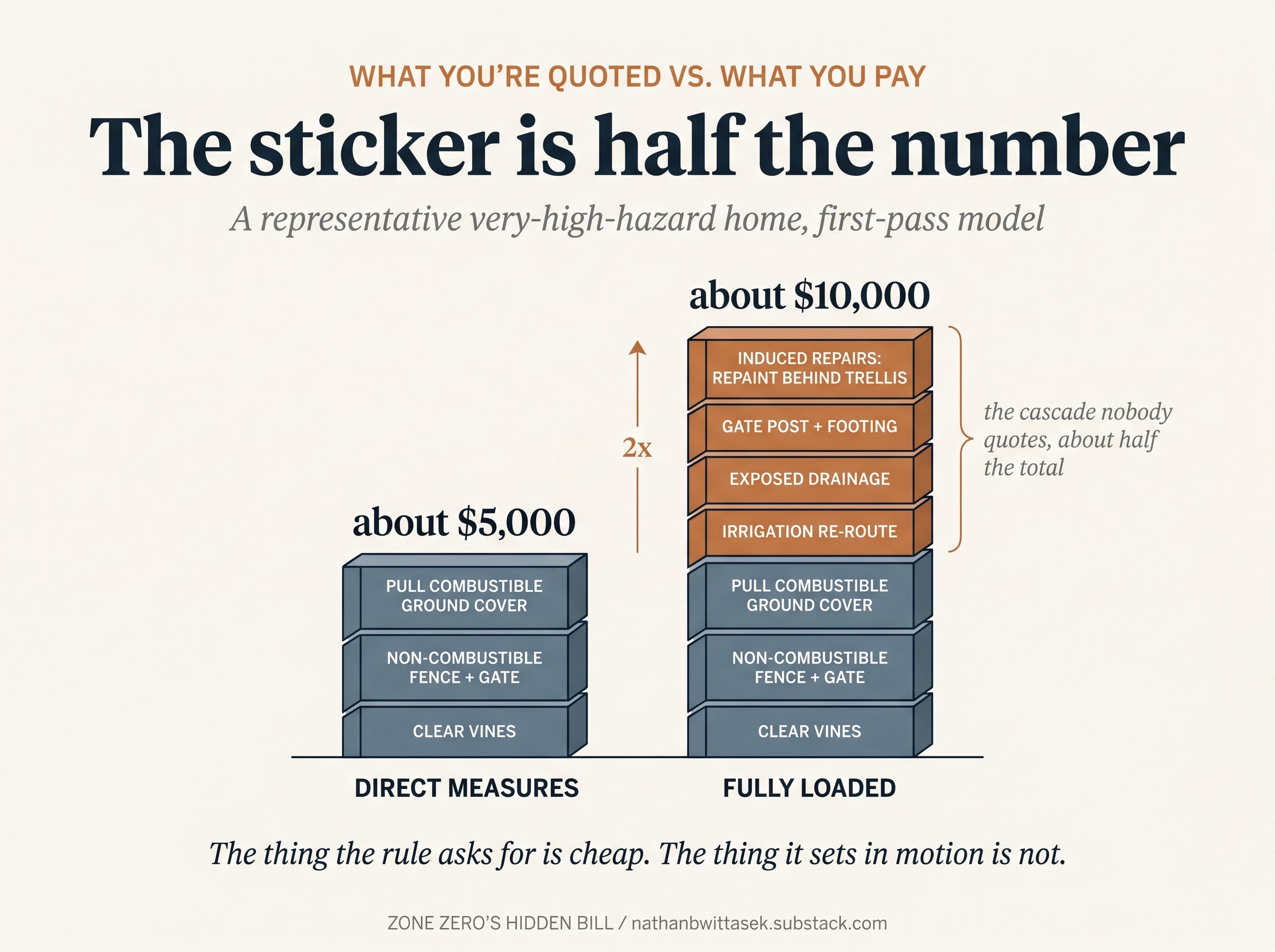
I ran the homeowner’s actual sequence through a first-pass model — direct measure plus the repair each measure forces, for a representative very-high-hazard home. The direct measures came to a few thousand dollars, exactly what you’d be quoted. Loaded with the induced repairs — the repaint behind the trellis, the gate and footing behind the fence, the drainage you exposed when you tore out the planting bed, the irrigation you have to cap and reroute — the fully-loaded number landed around $10,000. Roughly half of that total is the cascade the published estimates leave out.
The trellis is the cleanest example of the pattern, and the most extreme. Removing the vine and the trellis is almost free. The repaint it forces is most of the cost — on the order of 80 percent of that line item. The thing the regulation asks you to do is trivial. The thing the regulation causes is the bill.
I want to be honest about what that $10,000 is and isn’t. The direct costs are grounded in real per-measure data. The induced costs are engineering estimates — my read of what each measure typically triggers — not yet numbers collected from a stack of completed Zone 0 jobs. So treat it as a defensible first pass, not gospel. But the direction is not in doubt, and you can feel it the moment you pick up the first shovel: the loaded cost of Zone 0 is something like double the sticker, and the difference is hiding in the repairs.
Why the hidden bill matters more than the sticker
If the cost of Zone 0 were really a few thousand dollars, the political fight would be smaller and the adoption problem would be easier. People grumble at a few thousand dollars; they balk at ten. The reason the rule keeps hitting a wall is that homeowners are not stupid — they can see the repaint and the gate and the drainage coming even if the brochure can't. They are pricing the loaded cost in their heads while the agencies price the sticker on paper, and the two numbers are off by a factor of two. You cannot run a credible cost-benefit fight when one side is using a number that's half the real one.
This is also where the honest version of the argument actually helps the cause rather than hurting it. A deferred or hidden cost is where good policy goes to die, because the people who live with it always find out, and they punish the program that pretended the cost wasn't there. The fix isn't to keep quoting the cheap number and hope nobody notices the repaint. The fix is to price the loaded number out loud — and then build the support around the real figure. A $200-a-year insurance discount was never going to move a $10,000 loaded retrofit; I've written before about why that math stalls hardening. But a financing structure sized to the real cost, a discount calibrated to verified work, a Zone 0 standard that's honest about the cascade and helps homeowners sequence it so the repaint happens once instead of twice — those are real levers, and none of them work if the starting number is fiction.
There's a quieter design lesson in here too, for whoever finally writes the rule. The cascade is partly a function of how the requirement is drawn. A Zone 0 standard that forces you to disturb the wall, the fence line, and the drainage all at once produces one big induced bill. A standard that lets a homeowner phase the work — and that recognizes a maintained, mulch-free five feet without demanding you also re-landscape and repaint in the same season — produces a much smaller one. The physics doesn't care whether you spend $5,000 or $10,000. The ember lands on the same mulch either way. The cost is in the human details of the requirement, and those are still being written.
So here's the number I'd put in front of the Board, and in front of every homeowner doing the math at their own fence line: the cost of Zone 0 is probably about double what you've been quoted, and the difference is the repair the rule drags behind it. That's not an argument against Zone 0. The five feet is the highest-leverage money in wildfire survival, and I'd spend it first. It's an argument for telling the truth about the bill — because the version of this rule that survives contact with homeowners is the one that doesn't pretend the basement is free.
Watch the cost figures as the Board reconvenes. If the official number still has a single digit in front of the comma, somebody is quoting the fence and forgetting the wall.
Nate Wittasek, P.E., is the founder and CEO of Upresilience and a principal and partner at Simpson Gumpertz & Heger (SGH). He is Chair of the NFPA Technical Committee on Fire Protection Features (serving NFPA 101, Life Safety Code, and NFPA 5000, Building Construction and Safety Code) and a committee member on NFPA 1140 (Standard for Wildland Fire Protection). Views expressed are his own and do not represent the position of NFPA, its Standards Council and technical committees, or Simpson Gumpertz & Heger.